


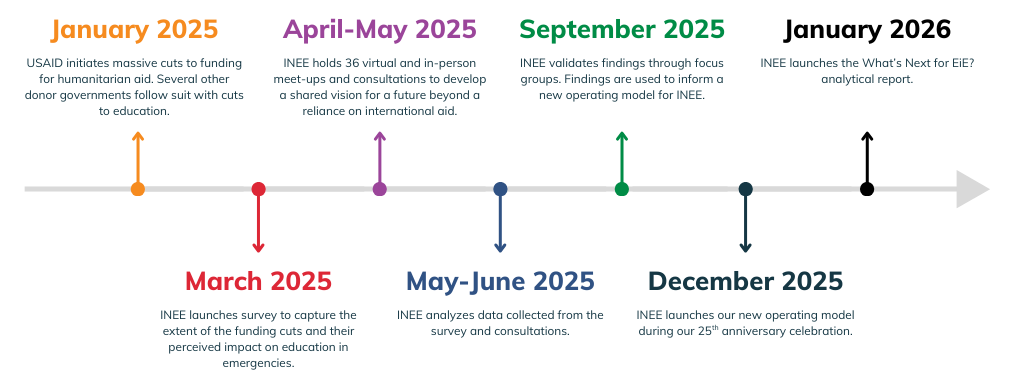
Beyond Aid: What’s Next for EiE, was born out of a simple truth: the way we have been doing things is no longer adequate. The global funding landscape for EiE is narrowing, and dependence on aid has become unsustainable. So far, this initiative has engaged more than one thousand voices across 66 countries—the voices of teachers, youth, governments, international agencies, non-governmental organizations, funders, and researchers—prompting them to reimagine a future for EiE that goes beyond traditional aid models.
From March-June 2025, INEE consulted its members through an online survey and a series of virtual and in-person Meet-Ups and focus group discussions. The survey captured quantitative and qualitative data on funding cuts and their perceived impact on education services, organizational adaptation and advocacy, and visions for a future beyond aid. INEE received inputs from 261 survey respondents in 66 countries and 5 languages.
To complement the survey findings, INEE, in collaboration with partner organizations, organized 36 consultations, which were attended by 810 members across the globe. Discussions were facilitated across different:
- Languages: Arabic, English, French, Portuguese, and Spanish
- Stakeholder groups: Teachers, students, donors
- Country contexts: Brazil, Colombia, Gambia, Ethiopia, India, Italy, Mexico, Niger, Nigeria, Palestine, South Sudan, Spain, Syria, Turkey, Uganda, Democratic Republic of the Congo, Afghanistan, Pakistan, Zimbabwe, Kenya, and Venezuela
- Thematic areas: Education financing, equity, inclusive education, gender, accelerated education, psychosocial support, and social and emotional learning
Beyond Aid: What's Next for EiE? Analytical Report
 This report synthesizes and analyzes member input from our survey and consultations. It reflects the immediate and far-reaching consequences of global aid cuts for EiE, including: school closures, reduced services, increased dropout, strained teachers, and deepening inequities for the most marginalized learners. Yet, alongside these challenges, the report also surfaces remarkable examples of community ingenuity that keep learning alive against all odds.
The report explores:
1. The concrete impacts of global funding cut: How shrinking resources are affecting learners, teachers, classrooms, and organizations, including the scale of budget losses, regional disparities, and the services most at risk
2. How EiE actors are adapting to a beyond-aid reality: Examples of local financing efforts, strengthened collaborations and advocacy, volunteer support, and community-led solutions innovations emerging across crisis-affected contexts
3. What needs to change and who needs to act: Sector-wide calls for centering learners’ realities, rebuilding the social contract among EiE stakeholders, actioning genuine localization, redefining the roles of INGOs and UN agencies, and funding what truly matters in crisis settings
In addition, the report synthesizes clear messages for INEE’s own evolution, highlighting the need for deeper regional presence, more decentralized structures, stronger support to national systems, and greater amplification of member-led knowledge and leadership.
Click here to access the resource.
Click here for a slide deck summarizing key findings.
Help us promote the report! Check out our social media package here.
Re-centering Education in Emergencies: A Localized INEE
 In response to member input reflected in the survey and consultations and further analyzed in the above analytical report, INEE has committed to a new, localized operating model. To meaningfully shift the center of gravity and challenge power structures within INEE and across the EiE sector, INEE will deepen its regional and national focus, bringing the network closer to the local realities of crisis-affected contexts, while reaffirming INEE’s commitment to remaining the sector’s principal convener and thought leader.
Education in emergencies cannot be sustained by business-as-usual approaches. The center of gravity must shift towards learners’ lived realities, teachers who hold classrooms together, governments that own and finance education as a public good, local organizations trusted to lead not just implement, and toward INGOs and funders who enable rather than direct.
Click here to access the resource.
We would appreciate your feedback on our new operating model! Share your insights in this survey, available in English, Arabic, French, Portuguese, and Spanish.
Want to learn more about our new operating model? Watch the launch event! This virtual event celebrated INEE’s 25-year journey — from its founding in 2000 to today’s vibrant network of more than 22,000 members. We also shared INEE’s focused vision designed to meet this moment and guide the network into its next chapter. Building on INEE’s role as the global standard-setter, convener, and knowledge broker for Education in Emergencies, our new vision models an intentional power shift towards locally led and globally backed solutions.
Member Stories
Embedded in our Beyond Aid: What's Next for EiE? initiative INEE reached out to education, child protection, and other humanitarian stakeholders and asked them to share their vision for a more equitable, inclusive, and sustainable sector. These short videos reimagine the EiE sector as one that is led by local actors, supported by innovative funding models, and bolstered by decolonial, anti-racist practices.
Blog Series
This collection of blogs is an effort by INEE to reimagine the education sector as one that is led by local actors, who are less reliant on traditional donors, and offer a fresh perspective of what EiE can look like in practice.
Scroll through the collection of blogs below and click to learn more.
- Reimagining Education in Emergencies: A conversation between Helena Murseli and Faiza Hassan, 26 March, 2025. By Helena Murseli, UNICEF; Faiza Hassan, INEE.
- Tax Justice and Education Financing Reform: A conversation between David Archer and Faiza Hassan, 3 April, 2025. By David Archer, ActionAid; Faiza Hassan, INEE.
- Education as Peacebuilding: The Hidden Key to Our Global Humanitarian Reset, 9 April 2025. By Kassaga James Arinaitwe, Teach For All, Teach For Uganda.
- Video series: What is your vision for the future of Education in Emergencies? 8 May, 2025. By Lauren Gerken, INEE.
- In Their Own Words: Teachers, Learners, and Practitioners on the Realities of Education in Emergencies, 12 May, 2025. By INEE, Teach for All.
- What’s Next for EiE: In conversation with Emma Gremley, 16 May, 2025. By Emma Gremley, International Rescue Committee; Faiza Hassan, INEE.
- What Does Meaningful Localization Look Like? A Conversation with Hani Mansourian, 16 June, 2025. By Hani Mansourian, Alliance for Child Protection in Humanitarian Action; Faiza Hassan, INEE.
- What’s Next for Education in Emergency Settings in Latin America and the Caribbean? A conversation with Ruth Custode, Sussana Urbano and Faiza Hassan, 27 June, 2025. By Ruth Custode, UNICEF; Sussana Urbano, Save the Children; Faiza Hassan, INEE.
- Localisation and the Future of EiE: Reflections from an INEE Country Focal Point, 10 July, 2025. By Fabiana Maglio, INEE.
- Social Justice Is Localization: What Refugee-Led Education Initiatives Teach Us, 8 January, 2026. By Lila Raouf.
Rethinking Humanitarianism podcast: Why emergency education saves lives
This episode from The New Humanitarian podcast features INEE's Director, Faiza Hassan. When aid funding is tight, education is often cut first. But schools offer more than just learning, and communities say education is their priority. "We have to believe that survival means more than just breathing." On this episode: Why disrupted schooling is the norm as climate change worsens, and the argument for prioritizing education in an era of aid cuts.