


Safe, Protective, and Affirming Education: Supporting LGBTQIA+ Learners in Emergencies
In June 2025, the INEE Gender Working Group held a roundtable on Safe and Affirming Education for LGBTQIA+ Learners in Emergencies. The event brought together a diverse group of organizations and individuals working at the intersection of gender equity, LGBTQIA+ rights, and education in emergencies (EiE) to:
- Identify barriers to and entry points for LGBTQIA+ affirming education in emergencies (EiE)
- Demonstrate how LGBTQIA+ learners can be supported in and through EiE, even in contexts where LGBTQIA+ rights are not acknowledged or supported
- Amplify the work of LGBTQIA+ rights organizations and queer youth organizations working in EiE
This blog aims to share key findings from the roundtable and amplify participants’ recommendations for ensuring that learning spaces are safe, protective, and inclusive of LGBTQIA+ learners, despite the increasingly restrictive funding and policy environment.
What's working?
To start, participants identified a number of challenges that LGBTQIA+ learners face in accessing quality, safe, and relevant EiE, including:
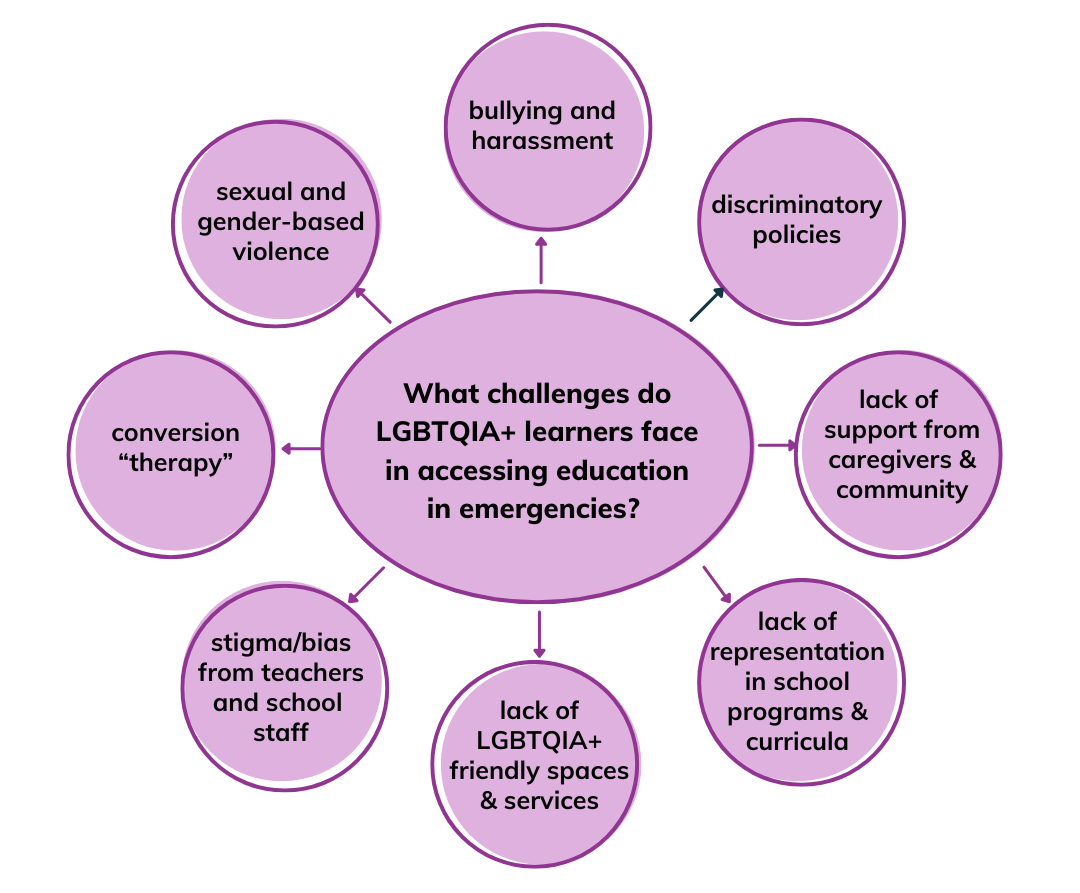
Despite this myriad of challenges, it was heartening to hear that a number of organizations have been taking a more proactive approach to ensuring LGBTQIA+ learners are safe, protected, and included in EiE. Participants shared examples of:
- Updating child safeguarding policies to include guidance on preventing or addressing homophobic and transphobic violence;
- Adapting comprehensive sexuality education curricula to include information on sexual and gender diversity;
- Providing teacher professional development on sexual and gender diversity and how to safely and productively challenge harmful gender norms and support LGBTQIA+ learners in their classrooms;
- Working with caregivers and community leaders to better understand LGBTQIA+ identities and available services for learners. Sharing culturally relevant examples of sexual and gender diversity to dispute narratives that LGBTQIA+ identities are a western imposition;
- Advocating to national governments for more inclusive education policies.
Throughout the roundtable, participants reiterated the need to work with education stakeholders at all levels, providing learners with peer support and mentorship opportunities, including engaging caregivers and community members in awareness raising campaigns, providing teachers with ongoing professional development opportunities, and working with local and national governments to identify and remove policy barriers. Participants stressed the importance of partnering with local LGBTQIA+ rights organizations to ensure interventions are culturally relevant, appropriate, and do not duplicate existing efforts.
They also highlighted the importance of cross-sectoral collaboration. Programming for LGBTQIA+ learners should aim to support their needs holistically, connecting them with resources and support related to education, protection, shelter, and physical and mental health.
What barriers remain?
Despite their best efforts, participants did share a number of challenges they had experienced while trying to provide open and targeted support for LGBTQIA+ learners:
- Data: There is very little data on LGBTQIA+ learners’ education access and experiences, making it difficult to develop programming that addresses their specific education needs. Nonbinary learners are particularly invisible in binary programs.
- Policy environment: 59 countries have laws, rules, and regulations that outlaw forms of expression related to sexual and gender diversity. In at least 19 of them, laws are specifically designed to apply to education, including banning books and educational materials on sexual and gender diversity and prohibiting educators from discussing sexual and gender diversity. In these contexts, many participants felt that sharing information about sexual and gender diversity or providing targeted support for LGBTQIA+ learners or teachers could compromise their safety or affect their organizations’ relationship with the government and their ability to work within formal education systems.
- Safety: It is illegal to be LGBTQIA+ in 62 countries, many of which are crisis-affected. Given the very credible risk of homophobic and transphobic violence and persecution in these contexts, LGBTQIA+ learners and teachers expressed that they did not always feel safe attending programming that openly targeted LGBTQIA+ people, as they feared being “outed” or victimized as a result of their association with these programs.
- Stigma: Even in contexts where participants were able to provide LGBTQIA+ affirming education programming, stigmatizing language and behavior (e.g., punishment or exclusion) was reinforced in some religious or cultural spaces, such as Christian or Islamic lessons.
- Teachers: Teachers and education personnel sometimes refuse to participate in education programs that reference LGBTQIA+ identities or contain guidance on comprehensive sexuality education, citing their personal or religious beliefs.
Where do we go from here?
Participants shared the following recommendations for a range of education stakeholders to better support LGBTQIA+ learners in EiE:
Teachers:
- Take time to reflect on your own beliefs and biases around sexual and gender diversity. Consider how your beliefs and behaviour may affect your learners’ self image, perception of their classmates, and feelings of safety and belonging in school.
- Immediately and consistently address homophobic and transphobic bullying and harassment in your school and classroom. Teachers and learners can be both victims and perpetrators.
- Review curricula and teaching and learning materials for inaccurate information and harmful stereotypes about sexual and gender diversity. Think critically about how you use these materials. Even problematic materials can be used to start a productive conversation about gender norms.
- Advocate for safe school policies, including a zero tolerance policy for homophobic and transphobic bullying.
- Advocate for teacher professional development on sexual and gender diversity and gender-responsive pedagogy. Consider setting up peer learning circles where you and your colleagues can discuss new information or techniques and collectively address any challenges you come across in the classroom.
- Connect parents and caregivers of LGBTQIA+ learners with safe and affirming services, such as LGBTQIA+ organizations, youth groups, and health services.
Education practitioners:
- Partner with local LGBTQIA+ organizations to develop culturally relevant and appropriate EiE programming. Build on existing, locally-led initiatives and provide capacity and/or resource support as needed.
- Provide teacher professional development on sexual and gender diversity and gender-responsive pedagogy. In addition to structured training, provide informal peer-learning opportunities, such as teacher learning circles or mentoring programs, where teachers can come together to examine their own beliefs and behaviours about sexual and gender diversity and collectively solve common challenges.
- Support governments to develop safe, protective, and affirming education policies, and remove institutional barriers to education for LGBTQIA+ learners and teachers.
- Support teachers, learners, and school leaders to develop and implement school codes of conduct, with zero tolerance for gender-based violence and homophobic or transphobic bullying and harassment.
- Connect teachers, education personnel, parents and caregivers of LGBTQIA+ learners with safe and affirming services, such as LGBTQIA+ organizations, youth groups, and health services.
Education policy makers:
- Repeal discriminatory policies that affect LGBTQIA+ learners’ access to and experience of education, including the prohibition of teaching and learning materials on sexual and gender diversity and sexual and reproductive health and rights and moratoriums on teachers discussing sexual and gender diversity in schools.
- Develop comprehensive safeguarding policies in schools. Ensure teachers and education personnel are trained to recognize signs of sexual and gender-based violence and respond compassionately and are familiar with reporting and referral mechanisms.
- Collaborate with local and national LGBTQIA+ organizations to ensure government interventions are relevant and appropriate.
- Build information on sexual and gender diversity and gender-responsive pedagogy into pre-service teacher training programs. Ensure teachers have access to continuous professional development on these topics, connecting them with external specialists (ex: women’s rights organizations, LGBTQIA+ rights organizations, sexual and reproductive health providers) if needed.
- Review and revise curricula and teaching and learning materials to ensure they do not perpetuate harmful stereotypes about LGBTQIA+ people. Embed LGBTQIA+ affirming content across the curriculum—not just in health or "diversity" units.
- Review and revise comprehensive sexuality education curricula ensure they are age-appropriate, medically accurate and inclusive of LGBTQIA+ identities. Provide teachers and education personnel with professional development opportunities to ensure they are comfortable and confident teaching this material.
Education funders:
- Accelerate funding to local LGBTQIA+ organizations working on education.
- Fund teacher professional development on sexual and gender diversity and gender-responsive pedagogy.
- Fund scholarships for LGBTQIA+ learners. Include costs for education materials, uniforms, and room and board, as LGBTQIA+ learners are more likely to be unhoused and unaccompanied.
- Fund research on barriers to and good practices in education for LGBTQIA+ learners in emergencies.
We recognize that this work is politically sensitive and potentially unsafe for education actors - especially teachers - in some contexts. Please consider your own safety before implementing these recommendations, especially those than are more public-facing. If you are in a situation where you want to support LGBTQIA+ learners in your programming, but don’t think it would be safe to do so openly, there are still options available to you. Even small actions like changing the language you use, actively listening to learners’ experiences, or quietly connecting learners with affirming services can make a huge difference whether learners feel safe and supported in learning spaces.
If you want to learn more about how you can create safe and affirming learning spaces for all learners for emergencies, check out INEE’s LGBTQIA+ Resource Collection. Want to help us amplify these recommendations? Check out our social media toolkit here.Want to help us amplify these recommendations? Check out our social media toolkit here.
About the Author
Lauren Gerken is the Gender and Inclusion Coordinator for INEE. She leads INEE’s work on gender and and girls’ education, coordinates the INEE Gender Working Group and hosts and produces the Educate Us! podcast. Lauren holds an M.A. in International Educational Development from Teachers College, Columbia University and a B.A. in Linguistics from the University of California, Berkeley. Lauren is based out of the New York offices of the International Rescue Committee.