


Social media toolkit: Sudan Crisis Spotlight
INEE has developed the following open source advocacy resources, based on inputs from INEE members living and working in Sudan. We encourage you to use this resource to highlight key statistics and messages about the crisis and amplify the voices of teachers, learners, and practitioners in Sudan. We appreciate your support in calling attention to this crisis!
For more information, key messages, tools, and resources, please visit INEE’s Sudan Crisis Spotlight webpage.
Handles and Hashtags
All published posts should use at least one of the following hashtags. Please tag INEE so we can help amplify your advocacy efforts.
Suggested hashtags: #CrisisSpotlight #KeepEyesOnSudan #ProtectEducationFromAttack
Social media handles:
- Facebook: @INEEnetwork
- LinkedIn: @Inter-agency Network for Education in Emergencies
- Bluesky: @inee.org
Graphic Assets
All campaign assets can be found in this Google folder. Each suggested post below includes a suggested asset to accompany the text.
Suggested Social Posts
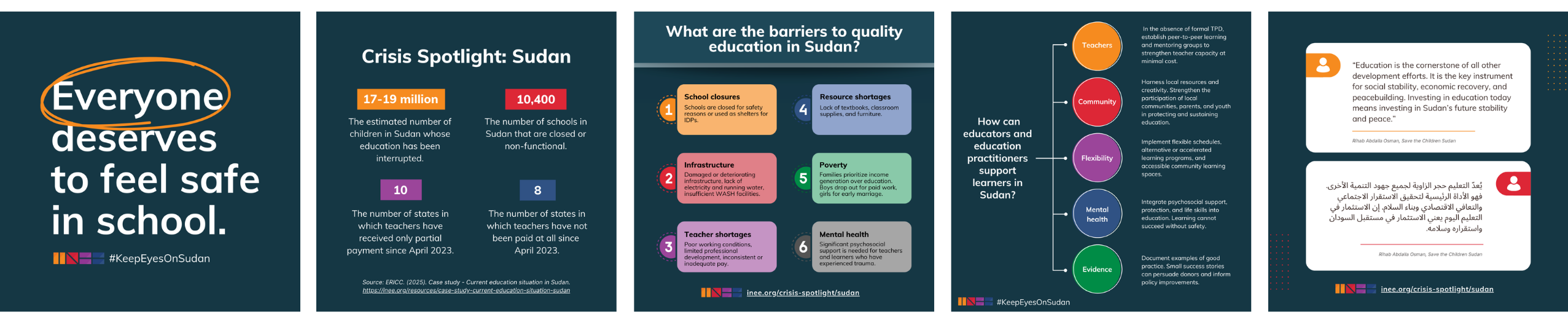
Post 1: Suggested graphic: Safe Schools (English, Arabic) or Statistics (English, Arabic)
#Sudan is experiencing one of the world’s largest and most under-reported #education crises. Since the escalation of conflict between the Sudanese Armed Forces and Rapid Support Forces in April 2023, the country has witnessed mass displacement, widespread destruction of infrastructure, and the near-total collapse of basic services—including education. Entire communities have been uprooted, with schools damaged, occupied, or converted into shelters, while millions of children have been cut off from learning.
Learn more at ➡️ inee.org/crisis-spotlight/sudan
Post 2: Suggested graphic: Barriers (English, Arabic)
What are some barriers to education in #Sudan? We asked, you answered:
✅Attacks on schools
✅Schools closed or used as shelters for IDPs
✅Insufficient or deteriorating school infrastructure,especially WASH facilities
✅Teacher shortages and reliance on untrained volunteer teachers
✅Irregular or unpaid teacher salaries
✅Lack of teaching and learning materials and classroom furniture
✅Outdated curricula and pedagogy and limited opportunities for teacher professional development
✅Insufficient and unsustainable funding for education
Learn more at ➡️ inee.org/crisis-spotlight/sudan
Post 3: Suggested graphic: Educators (English, Arabic), Quote #5
⁉️How can #educators and #education practitioners support learners in #Sudan?
✅Establish peer-to-peer learning and mentoring groups to strengthen teacher capacity
✅Strengthen the participation of local communities, parents, and youth in protecting and sustaining education
✅Implement flexible schedules, alternative or accelerated learning programs
✅Integrate psychosocial support, protection, and life skills into education
✅Document examples of good practice
Learn more at ➡️ inee.org/crisis-spotlight/sudan
Post 4: Suggested graphic: Policymakers (English, Arabic)
⁉️How can policymakers support #education in #Sudan?
✅Develop long-term strategic plans for education to anticipate and adapt to future shocks
✅Coordinate with international, national, and local initiatives and organizations
✅Recognize displaced communities not only as beneficiaries but as active partners
✅Invest in continuous #TPD and ensure timely and adequate payment to retain and motivate qualified teachers.
✅Adopt flexible policies for #EiE, recognizing alternative, accelerated, and non-formal learning
Learn more at ➡️ inee.org/crisis-spotlight/sudan
Post 5: Suggested graphic: Funders (English, Arabic)
⁉️How can funders support #education in #Sudan?
✅Provide flexible, multi‑year funding
✅Simplify administrative procedures to accelerate response in emergency contexts
✅Invest in local and national organizations and initiatives
✅Prioritize funding for teachers
✅Fund alternative, accelerated, and non-formal education
Learn more at ➡️ inee.org/crisis-spotlight/sudan
Post 6: Suggested graphic: Researchers (English, Arabic)
⁉️How can researchers support #education in #Sudan?
✅Adopt participatory and flexible research approaches to document local practices.
✅Invest in applied research led by national organizations and utilizing reliable local data
✅Provide actionable findings and encourage uptake by practitioners and policy makers
Generate evidence on:
✅The effectiveness of alternative and community-based education approaches
✅The educational experiences of girls and children with disabilities
✅the effectiveness of #PsychosocialSupport and #SocialAndEmotionalLearning interventions in education
Learn more at ➡️ inee.org/crisis-spotlight/sudan
Post 7: Suggested graphic: Call to Action (English, Arabic)
📣Sudanese children and youth have a right to education. Join us in demanding urgent, coordinated action to end the denial of the right to education for millions of children and youth in Sudan.
Learn more at ➡️ https://inee.org/resources/protect-education-now-call-action-uphold-right-education-sudan
Post 8: Suggested graphic: Quote #1
Education is a human right, and a legal obligation, even during conflict. However, millions of children in #Sudan are denied this right as the ongoing conflict continues to disrupt their education.
The education actors from Sudan call for increased funding and sustained support to restore and protect education.
Join us in amplifying their voices! Learn more
➡️ inee.org/crisis-spotlight/sudan
Post 9: Suggested graphic: Quote #2
Education is a life-saving intervention in emergencies, providing children with protection and routine, and supporting their wellbeing during challenging times.
The education actors working in and for Sudan are calling for education to be prioritized in emergency responses. Help us amplify their calls!
Learn more: ➡️ inee.org/crisis-spotlight/sudan
Post 10: Suggested graphic: Quote #3, Quote #4
Even in crisis, education continues — because communities make it so.
Sudanese teachers, school leaders, and communities have stepped up to keep learning going during extraordinary circumstances.
Read their stories, hear their voices, and explore their Call to Action to learn what is needed to continue supporting their efforts ➡️ inee.org/crisis-spotlight/sudan
Post 11: Suggested graphic: Quote #5
#Teachers are the backbone of #education.
Supporting teachers must be a priority when investing in education in #Sudan. Rebuilding schools is not enough. Sudanese teachers need fair and consistent pay, continuous professional development, and psychosocial support to rebuild the system from within.
Join us in advocating for the Sudanese teachers ➡️ inee.org/crisis-spotlight/sudan
Post 12: Suggested graphic: Quote #6
Young learners experience diverse challenges and needs during conflicts.
Policy and programs for rebuilding education in Sudan need to meaningfully engage youth to ensure their needs are reflected in education responses.
Join us in advocating for Sudanese youth ➡️ inee.org/crisis-spotlight/sudan
Post 13: Suggested graphic: Quote #7
Sudan faces an unprecedented education crisis.
But the stories from Sudanese teachers, school leaders, and communities, who have stepped up to keep learning going during extraordinary circumstances, offer hope of a better future.
Join us in supporting their work, and advocating for them ➡️ inee.org/crisis-spotlight/sudan