


Journal on Education in Emergencies Volume 10, Number 1
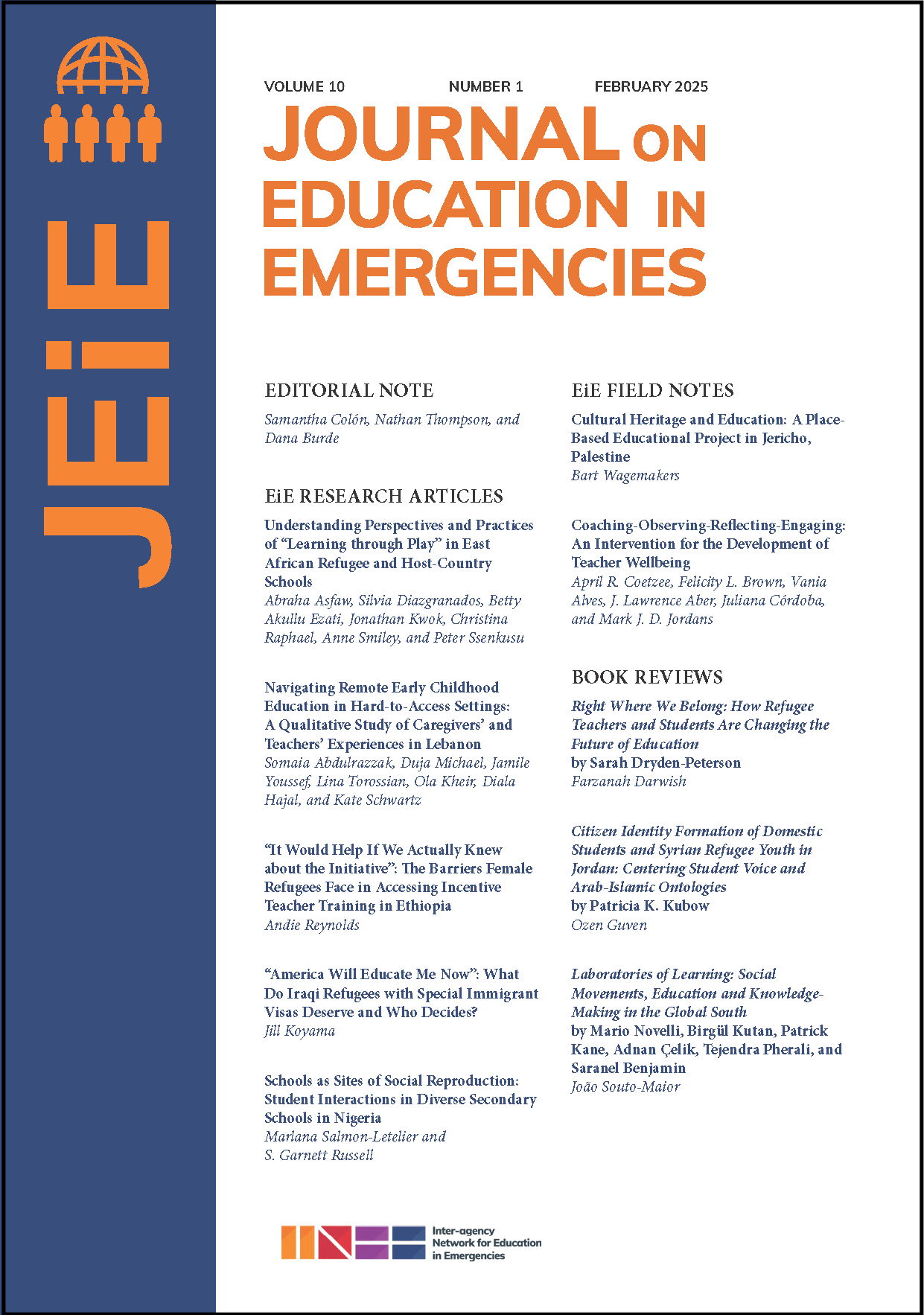 This issue of the Journal on Education in Emergencies (JEiE) samples the broad range of themes, contexts, disciplinary perspectives, and methodological approaches that represent research and practice in the field of education in emergencies. The articles in this issue of JEiE present evidence that underscores the need for education systems that are flexible, inclusive, and responsive to the social, cultural, and political conditions in which they operate. Creating such systems may help to bridge divides and foster understanding, compassion, and the provision of effective education in an increasingly polarized and violent world.
JEiE Volume 10, Number 1 includes five research articles, two field notes, and three book reviews. It offers cutting-edge scholarly and applied research conducted by teams of academics, practitioners, advocates, and policymakers who live and work among diverse populations in an array of settings, including Colombia, Ethiopia, Lebanon, Nigeria, Palestine, Tanzania, Uganda, and the United States.
The authors who contributed to this issue break new ground in our understanding of identity, belonging, and access to education. They explore the opportunities and challenges of refining and scaling play-based learning for refugee and host communities. They critically reflect on initiatives for supporting teacher wellbeing, training, and professionalization. And they share insights into how displacement, migration, and resettlement affect education experiences worldwide.
As a diamond open access journal, JEiE Volume 10, Number 1, as well as previous issues of JEiE and all individual articles, can be downloaded for free from the INEE website.
 The Journal on Education in Emergencies, published by the Inter-agency Network for Education in Emergencies (INEE), is licensed under a Creative Commons Attribution-NonCommercial 4.0 International License.