


Why Context Matters: Designing a Pedagogy of Care Professional Development Course for Afghan and Pakistani Refugee Educators
For the past five years, Right to Learn Afghanistan has been researching characteristics of quality teacher professional development (TPD) programs that promote care, belonging, and inclusion among teachers working with Afghan refugee students in northern Pakistan. Funded by Canada’s International Development Research Centre, the Care-Centered Networked Improvement Communities Research Project (CC-NIC) is studying how teachers can use “pedagogy of care” practices and strategies in their classrooms to build student-teacher and student-student relationships by working with teachers from other schools in networked improvement communities – a specific model of peer learning.
Pedagogy of care is a teaching approach that fosters emotional safety, trust, and responsiveness to students’ social and psychological needs alongside their academic development. It is particularly relevant for refugee education settings characterized by uncertainty. Our study examined the effectiveness of care-centred NICs as a model for professional learning that could be scaled in low-resource, multilingual refugee education contexts.
Early on in the project, it became clear that we needed to understand refugee teachers' lived experiences. “Context is everything,” especially in complex, multicultural environments. What was motivating Afghan and Pakistani teachers to promote care towards and among students, and what might be barriers to maintaining care in these classrooms? Were identity issues, like gender, refugee status, or ethnicity, or perhaps working conditions, factors in their capacity to care? We needed to listen closely to the voices of these teachers about their work before a course design could be finalized.
Right to Learn Afghanistan and our partner in Peshawar, the Area Study Centre of University of Peshawar jointly began to gather data about teachers’ lived experiences in eight primary schools (four boys’ schools and four girls’ schools) in refugee villages in Khyber Pakhtunkhwa province, northern Pakistan. We employed a combination of quantitative analysis and qualitative investigations through focus group discussions with 13 educators, to investigate infrastructure and resources, and how the perception of care in the daily practices of Afghan and Pakistani teachers. These findings were captured in "Situational analysis report of Afghan refugee schools in District Peshawar" (September, 2024), and referred to below.
Refugee education in Pakistan
Prior to visiting schools, the team familiarized themselves with both UNHCR and Pakistani education and TPD policies, which gave background to observations and teacher discussions. UNHCR supports education for about 57,000 registered school-age refugee children through 153 schools, and other educational entities. As of 2018, UNHCR Pakistan’s education policies mandate the application of the Pakistani curriculum, and prohibit the use of the Afghan curriculum (or the use of the Dari language) as part of its broader strategy to facilitate the integration of Afghan children into the public education system. These practices are consistent with the UNHCR’s global education strategy, which promotes “equitable and sustainable inclusion [of refugees] in national education systems, and “safe enabling environments that support learning…regardless of legal status, gender or disability.”. Meanwhile, in the larger geopolitical context, the Pakistani Government was continuing to systematically repatriate Afghans, including those with documented refugee status, a situation that has significantly deteriorated today.
School and teacher observations
Based on school observations and FGDs, while UNHCR continues to fund schools in refugee villages (RV), the adoption of the Pakistani curriculum and Urdu as the language of instruction and the decline in school-level funding has left both Afghan teachers and students feeling increasingly alienated and marginalized. We share a few findings below, as they relate to the design of the pedagogy of care curriculum.
School environment
“We have experienced times when even basic needs, such as water, were not met. Some classrooms lacked even a manual fan. The reality is that we work under conditions that, if you saw us, you would certainly admire us” (FGD1).
In our situational analysis, we found that refugee village schools faced dismal conditions. For instance, only three of the eight schools (38%) considered the water available at the school safe to drink. Only a third of the schools had functioning toilets for students and teachers respectively. Some of the physical classroom structures were unsafe. Notably, though, all schools in the study had access to the internet funded by UNHCR (though sometimes it was unreliable due to electricity shortages and device issues).
Class sizes ranged from 30 to 100 students, and dropout rates were high (30%) across all schools visited. Teaching and learning materials, beyond the teacher’s tablet, were largely non-existent. Most students had access to a textbook, but classroom walls were bare and storybooks or other learning materials were not available. Our school observations were consistent with school facility mapping exercises carried out by UNHCR Country Office Islamabad.
Teacher perceptions of themselves and their students
“Our work is similar to the Prophet’s duty. Although it may seem small, it is valuable and very important” (FGD representative).
Teachers held differing views of themselves and their role in society. One teacher told us: “When a person becomes respected and holds a good position in society with exemplary behaviour, it is often because they had a good teacher. If a teacher is not well trained they will not be able to develop students who exhibit good behaviour in society” (FGD2, p. 1). Another teacher reflected that, “our work is similar to the Prophet’s duty. Although it may seem small, it is valuable and very important” (FGD1, p.4). A teacher at the girls’ school said, “If you don’t treat a child as your own [emphasis added] and instead see them as a refugee and let them suffer, then as a teacher, you won’t be able to teach them properly. The first thing we need to do is to fix our mindset [by] viewing Afghan or Pakistani children as our own. This way, teachers cannot betray their responsibility” (FGD2, p. 2).
These comments suggest that teachers acknowledge the inclination to “other” Afghan refugee students and see them as lesser than their Pakistani peers. Yet, some may choose to see Afghan children as an extension of their moral responsibilities. “There is no difference between the two [Afghan and Pakistani children]”, one teacher said, adding, “I come here not just for a salary but to do the work required and the reward will come later” (FGD2, p.1). That reward includes honour: “If, God willing, something positive comes out of them, then our name will be honoured” (FGD2, p. 6). From this perspective, teaching is seen as an extension of religious duty and giving/receiving care may be considered central to fulfilling that duty.
“Unknowable futures”
“To my front is a big ditch, and at my back is a tiger.”
One Afghan teacher said, “Those of us teaching here lack sufficient experience, despite having good degrees. We don’t have any chance of obtaining permanent positions. Each day we come to work we fear that they will lay us off today or tomorrow…..Today we are like a labourer that if we get laid off, then everything is over for us. If we are teaching, we should receive the proper rights of a teacher” (FGD1, p. 3). The following statement captures what we heard over and over from the teachers: “I tell you honestly, my heart is very exhausted from teaching” (FGD1, p. 1).
An Afghan teacher living in Pakistan for over 40 years was conflicted over whether he should remain in these challenging circumstances in his host country of Pakistan, or return to the challenging circumstances of his country of origin, explaining that now, he “doesn’t know where to go.” He likens the situation of Afghan refugees to the Pashto proverb, “Makhe ta daang day aw sha ta prrang day” meaning ‘The front is a big ditch and the back is a tiger’. He added, “I still do not know what my future holds or whether the government of Afghanistan or Pakistan will accept me. Now, I find myself in an uncertain fate. [For] 40 years I don’t know from which side I am” (FGD1, p. 3). For him, like many teachers, the persistent uncertainty and ambiguity around where he belongs generates a pervasive sense of powerlessness and skepticism. This was also reflected in the comments of another teacher respondent, who asked “What should I say?” adding, “You speak but does anyone actually listen to us?” (FGD representative, p. 3).
These sentiments are captured well in the term “unknowable futures” coined by Sarah Dryden-Peterson (2017) in reference to refugee students. In the context of our study, they also apply to refugee teachers, who carry out their professional duties in a state of limbo that is multilayered and characterized by the uncertainty unleashed by macro political forces beyond their control.
Perceptions of cultural alienation
As social knowledge and identity are intimately linked, teachers’ comments suggested that Afghan history has been rendered invisible in the formal curriculum, reinforcing a sense of erasure among Afghan refugees and leaving some teachers conflicted. Interviewers asked teachers, “Do you use examples from Afghan education or stories and dialogues that reflect Afghan culture in your teaching to help students connect with their background?” One teacher responded, “We constantly think about this question in our minds and hearts. For instance, … our book does not include any content related to Afghanistan, and I have not been allowed to discuss Afghan topics. And I am not allowed to talk about Afghanistan.The book lacks relevant material, and I can’t deviate from its framework” (FGD1, p.5). At the same time, some teachers find opportunities to discretely bring in Afghan histories. A teacher at a girls’ school described discussing Afghan history and biographies, giving the example of Nazo Tokhi (1651 — 1717), commonly known as Nāzo Anā, who “raised a son for the world, for Afghanistan” (FGD2, p. 4).
“Afghan refugees are concerned about their children’s future and constantly question what their future will be like….Who will decide about their life, Pakistan or Afghanistan? If Pakistan decides …the curriculum should not be considered for them as they plan to return to Afghanistan and follow the Afghan curriculum there” (FGD1, p. 3).
Another Afghan teacher said, “There is nothing here anymore…At my school the flag of Afghanistan was put up properly. But it was taken down with great disrespect and insult. They put their feet on it. ….Pakistan for me is good compared to Afghanistan because I have lived here …for 32 years. But the love for my homeland never fades…..Actions like taking down flags reflect a lack of respect. …This isn’t just about schools. Now only Pakistani flags are displayed. There is no acknowledgement of Afghanistan. ….My homeland has not helped me, but the love for my native country remains in my heart and cannot be forgotten. This is an unchangeable truth” (FGD1, p.6).
Implications for course design
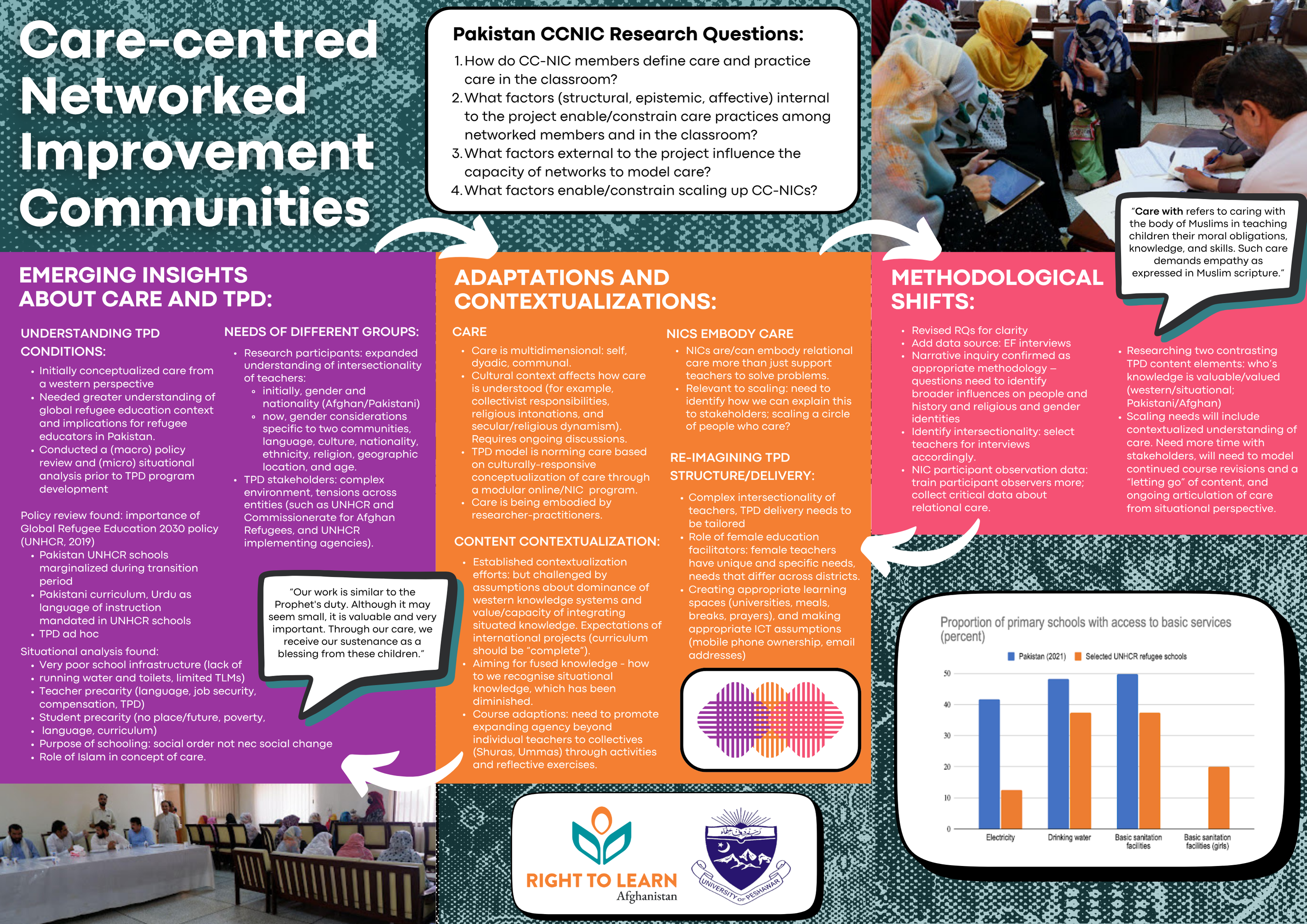
The CC-NIC content developers and instructional designers comprised team members of Afghan and Iranian origin as well as Canadian educators . Though the team had already drafted the course design, the situational analysis findings led them to significantly adapt and expand the course. Course developers realized the importance of going beyond dictionary style definitions of care to a more holistic conceptualization that would allow teachers to consider care “organically” and be introduced to a wide range of pedagogic approaches and strategies. The concept of “ethics of care” described in the research literature became the core around which course was designed:
On the most general level, we suggest that caring be viewed as a [human] species activity that includes everything we do to maintain, continue, repair our “world” so that we can live in it as well as possible. That would include our bodies, ourselves, our environment, all of which we seek to interweave in a complex, life-sustaining web. (Tronto, 1993, p.103).
Developers added an introductory module acknowledging the “uncertain future” of refugees, considering the experience of displacement of Afghan refugee teachers. It was agreed, after seeing the teachers’ comments, that Pakistani teachers would benefit from a better understanding of their refugee teacher peers. A module on teacher self-care and well-being became a prerequisite to the other modules, in response to the feelings of depletion expressed by respondents and the substandard working conditions they described. The value of promoting multicultural learning environments was introduced in the module on inclusion, and teachers were provided with a set of materials (colour paper, pens) to create more inclusive learning spaces in their classrooms. A module on student mental health was added as the final module, as designers gained a better understanding of the larger context of forced Afghan repatriation (targeting even documented refugees), which was causing significant stress in the Afghan community. While the concept of translanguaging was initially a course focus, designers dropped it for two reasons: the enforced language of instruction was a lighting rod for teacher supervisors, and for the reason that there was concern around allotting only a few hours to a complex topic (alongside many other topics) may be more confusing than instructive.
As modules were being drafted, they were negotiated and validated by our Pakistani and Afghan colleagues in Peshawar before finalization, through an established process and with the understanding that additional time would be required for this step. Ultimately, the eight modules comprising the CC-NIC Pedagogy of Care course became less biased by western thinking and practice, and more contextually relevant to educators and students in northern Pakistan.
A summary of the contextualization process is presented visually below, showing the research team’s shift in understanding about care.
The experience reinforced a lesson that extends well beyond this project: especially in contexts shaped by displacement, uncertainty, and cultural complexity, effective professional learning begins not with predetermined content, but with listening. By grounding course design in the lived experiences of Afghan and Pakistani educators, in our research we sought to move beyond assumptions about what teachers need, towards a model of professional learning that is responsive, locally meaningful, and rooted in relationships of care. In refugee education—as in many complex education settings—context is not simply the backdrop to professional development; it is one of its most important design principles.