


Scaling Refugee Teacher Professional Development: Lessons from Afghan Refugee Villages in Pakistan
In November 2025, Right to Learn Afghanistan co-facilitated an INEE Meet-Up at a critical moment for refugee education in Pakistan. With thousands of Afghan teachers and students being repatriated amid political upheaval, scaling teacher professional development (TPD) focused on inclusion was urgent. In the session, we highlighted preliminary research findings from a Global Partnership for Education (GPE-KIX) project examining inclusive education teaching practices among Afghan schools in Pakistan, and explored practical strategies for scaling this particular TPD approach for refugee educators beyond northern Pakistan. Discussions focused on how to maintain quality and inclusivity while ensuring that refugee educators receive sustained, context-sensitive support anywhere anytime during this period of instability and uncertainty.
What is Quality, Equitable TPD in Refugee Contexts?
As an entry point to our Meet-up discussion on scaling, we emphasized the transformative role of technology-mediated approaches to TPD in refugee education contexts. We also suggested that quality TPD must go beyond basic training. It should be regular, teacher-driven and culturally responsive, enabling educators to safely experiment with inclusive teaching strategies in their classrooms (Comstock et al 2023; Marín & Castañeda, 2022). It should integrate psychosocial support and provide digital literacy skills so that teachers can confidently navigate online learning and support students’ wellbeing (Pawan et al, 2023; Marín & Castañeda, 2022). Intentional “focused collaboration” with peers allows teachers to share and actively reflect on their classroom experiences.
Scaling Refugee Education TPD
The International Development Research Centre (IDRC), based in Canada, emphasizes the importance of scaling research innovations. Researchers are responsible for sharing tested models broadly (in this case, a TPD approach), and supporting institutions and organizations to adapt interventions to local contexts. According to IDRC, scaling is the intentional process of expanding, adapting, and sustaining successful interventions to achieve widespread, equitable benefits. As we discussed with Meet-Up participants, scaling should be intentional from the inception of a pilot. In refugee teacher professional development, scaling involves three interconnected approaches:
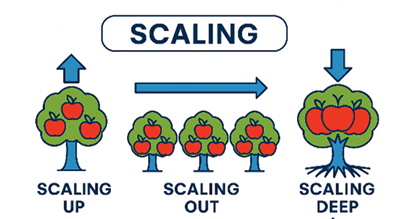
- Scaling up: Expanding coverage and uptake for a change initiative by embedding evidence-based TPD models into national policies, institutional frameworks, and government systems to secure long-term adoption and sustainable resource allocation.
- Scaling out: Extending programmes horizontally to new schools, communities, or regions to reach more refugee teachers and learners.
- Scaling deep: Changing relationships, cultural values and beliefs, and strengthening cultural relevance and the transformative impact of TPD by embedding principles of inclusivity, ensuring meaningful shifts in teaching practices and in educator mindsets.
Our scaling strategy targeted UNHCR and other organizations to scale the TPD programme out to other schools in the region, and up through the UNHCR and Government of Pakistan education systems. The regional Department of Education was engaged from the beginning, and may be considered a scaling partner in the future.
Lessons on Scaling of Refugee Education TPD
Scaling quality programmes in a refugee context is complicated, especially during this current period of global transition. Host countries, aligning with the Education 2030: A Strategy for Refugee Inclusion, are trying to integrate refugee students into national education systems, some of which are already over-burdened. The challenges can be exacerbated by political tensions and security risks between host countries and refugee countries of origin, as was the case in Pakistan during the research project.
Right to Learn and our local partners identified a number of potential factors contributing to effective scaling.
1. Organizations need sufficient capacity and leadership support to scale
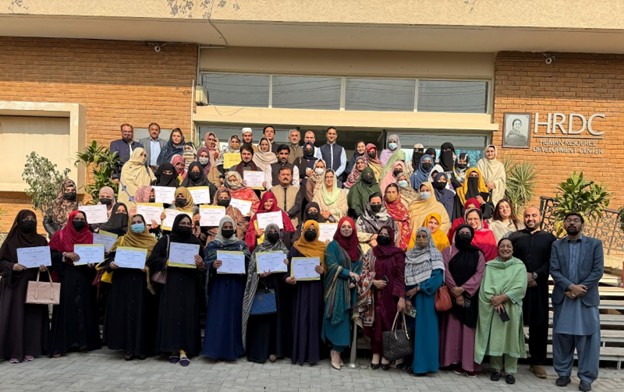
As we shared with Meet-Up participants, in June 2025 the UNHCR Peshawar sub-office adapted and scaled the inclusive education programme utilizing networked improvement communities (NICs), which are collaborative professional learning groups that bring together school leaders to solve educational problems using a continuous improvement approach. In doing so, UNHCR Peshawar mobilized education facilitators and provided ongoing technology support to 30 teachers in two districts. Most (87%) of these teachers completed all programme requirements, despite ever-present uncertainty. They were honoured at a graduation ceremony in September. Based on this pilot, UNHCR Peshawar scaled out the programme to additional cohorts of teachers of refugees.
What has contributed to this scaling success? Against the backdrop of Afghan repatriation, senior UNHCR education managers were determined to support teachers wherever they were. And with this leadership support, UNHCR resources were mobilized for successful scaling and dedicated to operationalizing the programme at the school level.
2. Collaborative teacher mechanisms such as networked improvement communities support scaling
Establishing networks of trained refugee and host-community teachers creates collaborative spaces where teachers can learn from one another, share resources, and co-develop inclusive practices. These networks act as peer-learning communities, fostering continuous professional growth and reducing reliance on external facilitators. By promoting mutual support and knowledge exchange, teacher networks make scaling efforts more sustainable and contextually relevant.
3. Engaging a broad range of stakeholders mitigates changing mandates
In crisis contexts, organisations mandated to scale can suddenly contract. Our research was conducted in refugee villages in Pakistan. From project onset, we targeted UNHCR offices in Peshawar and Islamabad, the Commissionerate for Afghan Refugees, and the Department of Education as viable scaling partners, and included them in meetings, course design workshops, and launches and graduations. Today the mandate of these institutions in support of Afghan refugees may be changing considering the current political and security challenges between the Pakistani Government and the Taliban in Afghanistan. Pivoting activities to onboard new scaling partners needs to be integrated throughout the project cycle. Considering Afghan refugees are being repatriated to Afghanistan, we were encouraged by Meet-Up participants to consider UNHCR and other entities in Afghanistan as new scaling partners, and since the Meet-up, we have had positive scaling meetings with UNHCR Afghanistan who are interested in scaling TPD among repatriated Afghans.
You can learn more about Right to Learn Afghanistan’s Inclusive Education TPD approach here:
- Improving Inclusive Education Practices for UNHCR Educators (online course)
- How can Networked Improvement Communities help School Leaders address inclusion challenges in their schools? Evidence from Nepal, Pakistan and Afghan Refugee Schools
About the Authors
 Through her work with Right to Learn Afghanistan (RTLA), Sacha Innes leads an IDRC-funded research project which is part of the “Empowering Teachers Initiative”. She also manages an GPE-KIX “furthering impact grant” allowing RTLA to continue supporting UNHCR and INEE stakeholders to scale quality, equitable technology-mediated teacher professional development programmes. Ms. Innes supports Afghan teachers as part of the RTLA’s online school serving over 600 Afghan adolescent girls.
 Dr. Saraswati Dawadi is currently a Research Fellow at the Institute of Educational Technology, The Open University, UK. Her research has a key focus on technology use for pedagogical purposes, open education, girls’ empowerment and inclusion.She brings a significant experience of teaching and research, and engagement with external/internal stakeholders to ensure educational programmes are tailored to local needs and context.