


Reimagining Social and Emotional Learning: From Individual Competencies to Systemic Transformation
Over the past three decades, Social and Emotional Learning (SEL) has gained prominence as a global educational imperative. Its evidence base is well-established, with studies consistently showing that SEL enhances students’ emotional regulation, interpersonal competencies, and academic achievement. Yet, many mainstream SEL programs remain narrowly focused on building individual skills such as self-control, empathy, or perseverance, without addressing the broader realities in which children live and learn. These approaches often emphasize discrete skills while neglecting the wider social, political, and emotional ecologies that shape students’ lives.
This commentary argues that SEL must move beyond a narrow focus on individual behaviour. It should adopt a systemic, equity-centered, and intersectional approach, one that not only supports students in navigating adversity, violence, or displacement but also empowers them to challenge and transform the systems that perpetuate these conditions.
Beyond the Skillset: The Promise and Pitfalls of SEL
When done well, SEL programs are successful at fostering empathy, perspective-taking, and collaboration. However, in many contexts, especially those marked by structural inequality or crisis, SEL has been reduced to an add-on intervention aimed at improving classroom management or student behaviour. This reduction risks disconnecting SEL from the lived realities of young people, particularly those navigating poverty, violence, exclusion, or displacement.
This narrow framing can unintentionally overlook or even pathologize the ways young people respond to trauma or injustice. For example, emotional withdrawal or classroom defiance may be interpreted as poor self-regulation rather than as valid responses to chronic adversity. Such approaches reinforce deficit-oriented narratives and fail to interrogate the systemic causes of emotional struggle.
Who Gets to Thrive? Rethinking Emotional Development in Contexts of Adversity
Children do not arrive at school as emotional blank slates. For many students, particularly those from under-resourced or historically marginalized communities, schooling is layered with unspoken trauma and exclusion. In such contexts, SEL that fails to recognize social and political inequalities risks deepening, rather than disrupting, injustice.
Emerging frameworks in trauma-informed education and culturally sustaining pedagogy emphasize the importance of relational safety, dignity, and belonging as preconditions for learning. However, many SEL initiatives lack the cultural and contextual sensitivity required to serve students holistically. Without grounding SEL in the material realities of students’ lives, efforts to build emotional competencies may fall short.
Insights from the OECD Survey on Social and Emotional Skills
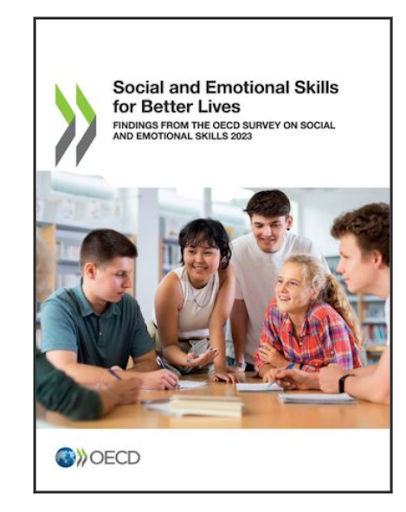
Recent findings from the OECD’s Survey on Social and Emotional Skills (SSES) in which India also participated, offer valuable insights for rethinking SEL through an intersectional lens. The survey assessed 15-year-old students on a range of social and emotional skills, such as empathy, self-efficacy, and stress resistance, while also examining how factors related to home environment, school experiences, and individual background, including gender, socio-economic status, and migration, shaped these outcomes.
The insights below draw from data collected in India as part of the OECD SSES.
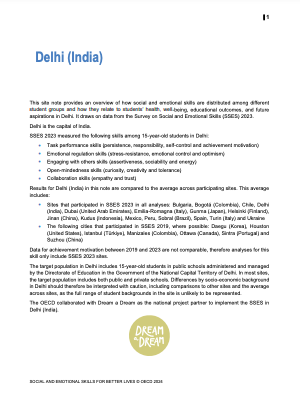
Key findings include:
- Girls reported higher levels of empathy, assertiveness, and creativity than boys, defying global patterns, but lower emotional control and stress resistance, pointing to the emotional toll of gendered expectations.
- Students from disadvantaged households generally reported lower self-regulation and optimism, suggesting that economic insecurity significantly affects emotional well-being.
- Migrant students reported lower levels of social and emotional skills compared to host community peers in Delhi, particularly in adaptability and tolerance, reflecting the localized psychosocial impacts of displacement and exclusion.
These findings confirm that emotional development is not evenly distributed. It is shaped by systemic factors: gender roles, income inequality, and migration that determine access to emotional safety and support.
Toward a Systemic and Equity-Driven SEL
To fulfil its potential, SEL must evolve from isolated, skills-based interventions into a whole-system approach embedded within school culture, pedagogy, and policy. This requires several key shifts:
- Integrating SEL into teacher education and professional development so that educators are equipped to understand and support the complex emotional lives of their students.
- Designing culturally relevant curricula and assessments that affirm diverse identities, languages, and ways of knowing.
- Institutionalizing student voice, belonging, and emotional safety as foundational commitments in school improvement efforts.
Such a vision calls for policy shifts that position emotional well-being as central, not supplementary, to the goals of education. Emotional development must be prioritized alongside academic achievement and civic engagement.
Intersectionality as a Necessary Framework
A truly transformative SEL must incorporate intersectionality, a framework that explains how overlapping systems of power shape individual experience. This involves recognizing how caste, gender, ethnicity, disability, and socioeconomic status intersect to influence not only access to education, but also the emotional experience of schooling.
An intersectional approach to SEL would include:
- Encouraging emotional expression among girls and boys without reinforcing binary gender norms.
- Supporting migrant students through multilingual and culturally affirming practices.
- Centering trauma-informed pedagogies that address the emotional impact of poverty, violence, and exclusion.
Without adopting this lens, SEL risks becoming a compliance mechanism that shapes behavior without transforming the systems that marginalize students in the first place.
Reclaiming SEL as a Pathway to Justice
At its most powerful, SEL is not simply a method for improving emotional regulation or stress management. It is a means of reimagining education. SEL can help build relational schools, create more just systems, and foster collective healing. To achieve this vision, SEL must be decolonized, contextualized, and democratized.
There is a growing call within the global education community to align learning with the broader goals of human dignity, social cohesion, and planetary well-being. SEL can contribute meaningfully to this effort, but only if it moves beyond narrow, technocratic formulations. It must become a transformational ethos rooted in equity, care, and justice.
About Dream a Dream
Dream a Dream is a Bangalore-based non-profit committed to reimagining education in India by embedding life skills and social-emotional learning (SEL) into school systems. Its mission is to equip young people from vulnerable backgrounds with the tools to thrive in a dynamic world. With a strong emphasis on systemic transformation, the organization strives to build a more inclusive and equitable education ecosystem. As the National Project Partner for India in the OECD’s Survey on Social and Emotional Skills (SSES), Dream a Dream led the second round in 2023 and continues this role in Round 3 (2025–2027), contributing evidence and advocacy to promote SEL and support education systems to enable young people to thrive.
Acknowledgments:
We extend our sincere gratitude to the OECD-SSES team for their valuable inputs and dedicated support throughout this process. In particular, we thank Noémie Le Donné, Catarina Gress-Wright, Gemma Coleman, Ivona Feldmárová and the wider team whose efforts and expertise were instrumental in shaping the report for round 2 for SSES.
We also gratefully acknowledge the review support for this blog provided by Ms Anagha C and Ms Saba Ahmad from Dream a Dream.
The full report is available here.
About the Authors:
 Dr. Sreehari Ravindranath is the Director of Research and Impact at Dream a Dream, Bangalore. A psychologist by training, he works on social and emotional learning, well-being, and education reform, and serves as National Project Manager for India for the OECD Social and Emotional Skills Survey (Round 2 and 3).
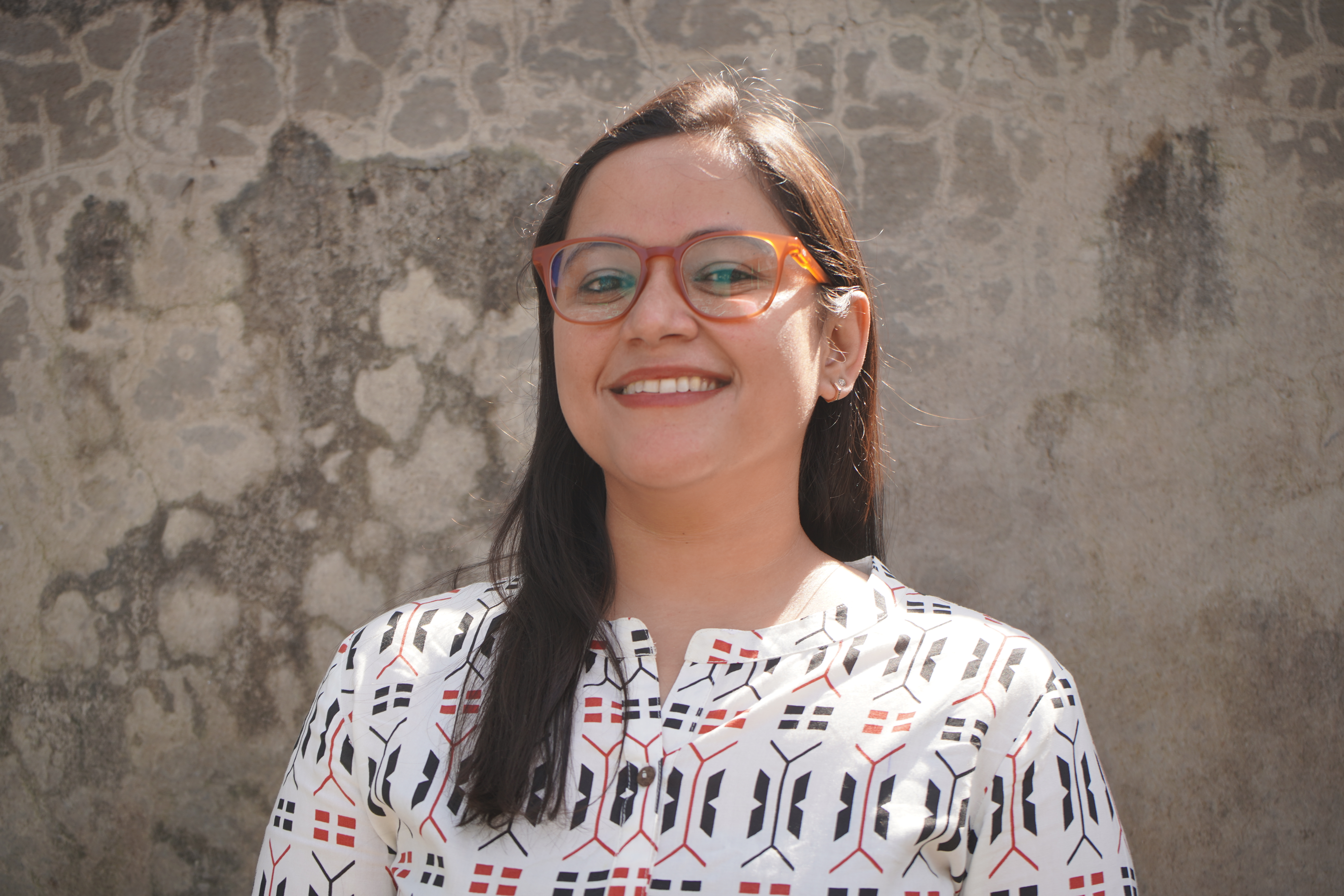 Ms. Apoorva Bhatnagar is Manager – Research & Impact at Dream a Dream. She works on education systems transformation, research–policy engagement, and social and emotional learning. She serves as the National Project Coordinator for India for the OECD Social and Emotional Skills Survey (Round 2 and 3).
 Dr. Joseph Thomas is the Associate Director – Research & Impact at Dream a Dream, Bangalore. A data and education researcher, he brings expertise in big data analysis, social and emotional learning (SEL), and pedagogical reforms. He serves as the National Sampling and Data Manager for India for the OECD Social and Emotional Skills Survey (Round 2 and 3).
 Mr. Amit V Kumar is the Associate Director – Research & Impact at Dream a Dream, Bangalore. He brings an expert focus on the intersection of education, ethics, and emerging technologies. He serves as the National Quality Manager for India for the OECD Social and Emotional Skills Survey (Round 2 and 3).